Every time we quote a full re-roof we get the same question. "Is natural slate really worth it, or should we go concrete tile and put the difference in the kitchen?" It is a fair question, and the honest answer requires more than a per-m² comparison. Roofs are a 40+ year decision. Priced right, either material works. Priced wrong, one of them costs you three times more than it should.
Headline: Natural slate wins the 40-year comparison by roughly £6,500 on a typical 100m² three bed semi. Concrete tile is cheaper on day one and cheaper for the first 25 years. After that, the maths tips.
The day one number
On a three bed semi with a 100m² pitched roof, in 2026, here are the full re-roof supply-and-fit ranges:
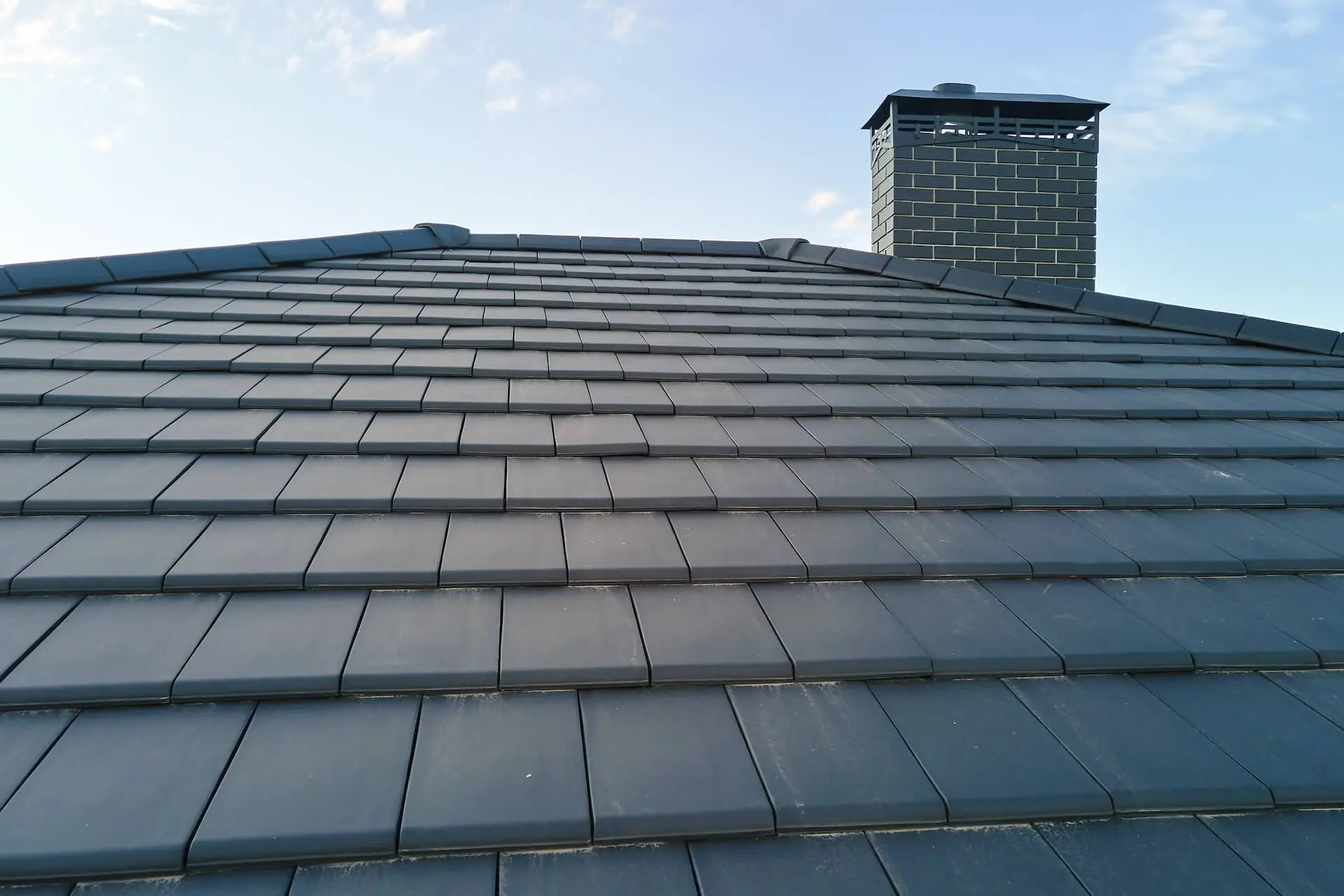
- Interlocking concrete tile: £9,500 to £13,500 (£95 to £135 per m²).
- Plain clay tile: £12,000 to £16,500 (£120 to £165 per m²).
- Natural slate (Spanish, standard grade): £15,500 to £20,500 (£155 to £205 per m²).
- Natural slate (Welsh, premium): £22,000 to £29,000 (£220 to £290 per m²).
For the 40-year comparison below we take the mid-point on each: £11,500 for concrete tile, £18,000 for Spanish natural slate. That £6,500 difference is the number people focus on. It is not the number that matters.
Lifespan and what "lifespan" actually means
Manufacturers quote lifespan generously. Real-world lifespan (the point where the covering starts costing more in repair than replacement) is shorter. Here is what we actually see in the field:
- Interlocking concrete tile: 40 to 55 years. First replacement usually needed around year 45 to 50 on a well-installed roof.
- Natural slate (Spanish standard grade): 80 to 100 years. Almost never needs replacement inside a normal ownership window.
- Natural slate (Welsh premium): 100 to 150 years. Some Welsh slate on Victorian terraces around Bletchley is still original.
The concrete tile roof will very likely need one full replacement inside 40 years. The slate roof will not.
The 40-year cash flow, side by side
On the same 100m² three bed semi, here is what each roof actually costs over 40 years, in 2026 pounds. We assume 3% annual construction inflation for future work.
Concrete tile:
- Year 0: install £11,500.
- Year 15: minor repair (ridge, verge, small area of slippage) £600.
- Year 25: mid-life review, replace failed underlay under one slope, ridge dry-fix upgrade £3,500.
- Year 42: full replacement at 2068 prices, roughly £27,000 (£11,500 today at 3% for 42 years).
- 40-year total: approximately £31,000 across two full replacement cycles.
Natural slate (Spanish standard):
- Year 0: install £18,000.
- Year 20: preventative check, re-flash chimneys, minor slate replacement £1,200.
- Year 40: cosmetic inspection, no work required.
- Year 40+: original slate still in service. Underlay and battens might be end-of-life inside another 20 years, but the slate covering does not need to change.
- 40-year total: approximately £19,200.
Difference over 40 years: slate wins by about £11,800 on this profile. Even accounting for uncertainty, the direction of the answer is not close.
Slate only wins if you actually stay in the house 25+ years.
Move within 10 years and concrete tile is the cheaper choice. Any longer and slate starts working in your favour. If you are unsure, factor in the resale premium next.
The resale premium
Estate agents in Buckinghamshire consistently value a natural-slate roof £8,000 to £15,000 higher than a concrete tile equivalent, on a like-for-like three bed semi. On period properties and in conservation areas the gap widens further (up to £25,000 on Georgian and Victorian frontages where slate is expected).
Concrete tile on a period property can actively hurt resale, particularly if a previous owner replaced original slate with concrete during the 1970s or 80s. A slate re-roof on that same house often pays for itself immediately on market value.
If we assume even a modest £8,000 uplift on resale, slate pushes further ahead on the 40-year comparison. On heritage properties, the maths becomes conclusive.
Maintenance realities
Slate requires almost no active maintenance. The most common failure point is nail fatigue in the fixings, not the slate itself, and that is easy to spot on a routine 5-year survey. Ridge tiles bedded in mortar do fail inside 15 years, which is why modern re-roofs use dry-fix ridge on both slate and concrete.
Concrete tile requires slightly more. The tiles themselves are hard-wearing but the underlay ages faster because concrete is less breathable than slate, meaning trapped moisture stresses the felt. Efflorescence (white salt marks) on the tile surface can appear after 20 years and is cosmetic only, not structural.
When concrete tile is still the right call
Slate is not always the answer. Concrete tile wins in three scenarios:
- Modern new-build (2000+) with existing concrete tile. Like-for-like replacement is cheaper and does not risk mismatching the estate aesthetic.
- Sub-30 year ownership horizon. If you know you are selling inside a decade, concrete tile is cheaper per year of use.
- Structural constraints. Slate weighs more than concrete tile. Older rafters occasionally need reinforcement to carry slate. If reinforcement pushes the job by £5,000, the maths shifts.
For a broader comparison of every common pitched roof material, see our slate vs clay vs concrete guide.
Getting a like-for-like quote
Any roofer can quote both materials for the same house. Ask three specific questions on each quote:
- Which manufacturer and slate/tile grade is being used, and is it in stock?
- What underlay is specified (Klober Permo, Tyvek Supro, or generic)?
- Is the ridge dry-fix or mortar-bedded (dry-fix should be the answer in 2026)?
Then compare the two numbers with a clear head. Our pitched roofing service covers how we spec each material, or head straight to the contact form for a free written quote against your own property.