Almost every pitched roof you'll see driving through the Buckinghamshire villages, the Milton Keynes estates or the Bedford commuter belt is finished in one of three materials: natural slate, clay tile or concrete tile. Between them they cover something like 95 per cent of the UK's residential pitched roofs. Yet ask ten homeowners what the difference actually is, and you'll get ten hesitant answers.
That's understandable. Nobody thinks about the roof over their head until it starts leaking, and by that point the choice is being made under time pressure, alongside a stack of quotes with unfamiliar product names on them. This piece is the family's plain-English attempt to explain the three materials properly, so if a re-roof is on your horizon you can walk into the survey knowing broadly what you're looking at.
How the three tiles compare at a glance
Before we get into the character of each, here is the short version. Everything below is a genuine working comparison, not a manufacturer's brochure, and reflects real installed prices in our patch of the country as of 2026.
| Property | Natural Slate | Clay Tile | Concrete Tile |
|---|---|---|---|
| Typical lifespan | 100 years plus | 60 to 80 years | 40 to 60 years |
| Weight per m² | 25 to 30 kg | 40 to 55 kg | 50 to 65 kg |
| Minimum pitch | 25 to 30° | 30 to 40° plain, 22.5° interlock | 17.5 to 22.5° |
| Installed cost per m² | £140 to £220 | £80 to £130 | £55 to £90 |
| Kerb appeal | Highest, on the right property | Warm, mellow, ages beautifully | Functional, colour fades over time |
| Best suited to | Victorian, Edwardian, listed, contemporary | Period cottage, 1930s semi, quality new build | 1960s onward, volume housing, budget re-roofs |
Now the honest detail on each.
Natural slate: the 100-year roof
Slate is a metamorphic rock, split by hand or by machine into thin sheets. British Welsh slate, quarried since the eighteenth century in Snowdonia and Ffestiniog, is the benchmark. Spanish slate is the volume alternative most commonly seen on modern UK re-roofs, cheaper per tonne, lighter in weight, largely indistinguishable to the untrained eye. Both, laid properly, will outlast almost every other component of the building.
The reason slate lasts is that the material is chemically stable. It doesn't absorb water, it doesn't oxidise, it doesn't fade in UV. Once quarried and dressed it is essentially inert. What eventually fails on a slate roof is not the slate itself. It's the nails holding it (iron nails corrode, copper nails effectively last forever), the timber battens beneath, the underlay if fitted, or the mortar bedding on the ridges. The slate itself sits there quietly for a hundred years, or three.
When it makes sense
Slate is the correct answer on Victorian and Edwardian property, on any listed building where planning permits the material, on stone or high-status brick cottages in conservation areas, and on architect-designed contemporary homes where the client wants the roof to read as a considered piece of the design. It's also the honest answer whenever the existing roof is slate, matching what was there is nearly always what a conservation officer expects, and what the property looks best in.
What it costs
Slate is the most expensive of the three by some distance. Expect £140 to £220 per square metre installed, depending on whether you specify new Spanish slate, new Welsh slate or reclaimed Welsh slate, which is often used to keep the character of a period property. On a typical three-bedroom semi with 90 square metres of roof, you're looking at £13,000 to £20,000 in slate work alone, before scaffolding, felt, battens, ridges and lead. A full slate re-roof on the same property usually lands in the £18,000 to £30,000 bracket.
What can go wrong
Two things, mostly. First, nail sickness: the original iron nails corrode after 80 or 90 years and slates begin to slip one by one. The slate is still perfect, the fixing has failed. This is usually the trigger for a strip and re-lay on a Victorian roof, where the original slate can often be reclaimed and re-used. Second, poor workmanship on the joints: slate is unforgiving of sloppy detailing at the ridge, at the abutments and around chimneys. On a well-laid slate roof, the lead-work is as important as the tile.
Clay tile: the workhorse
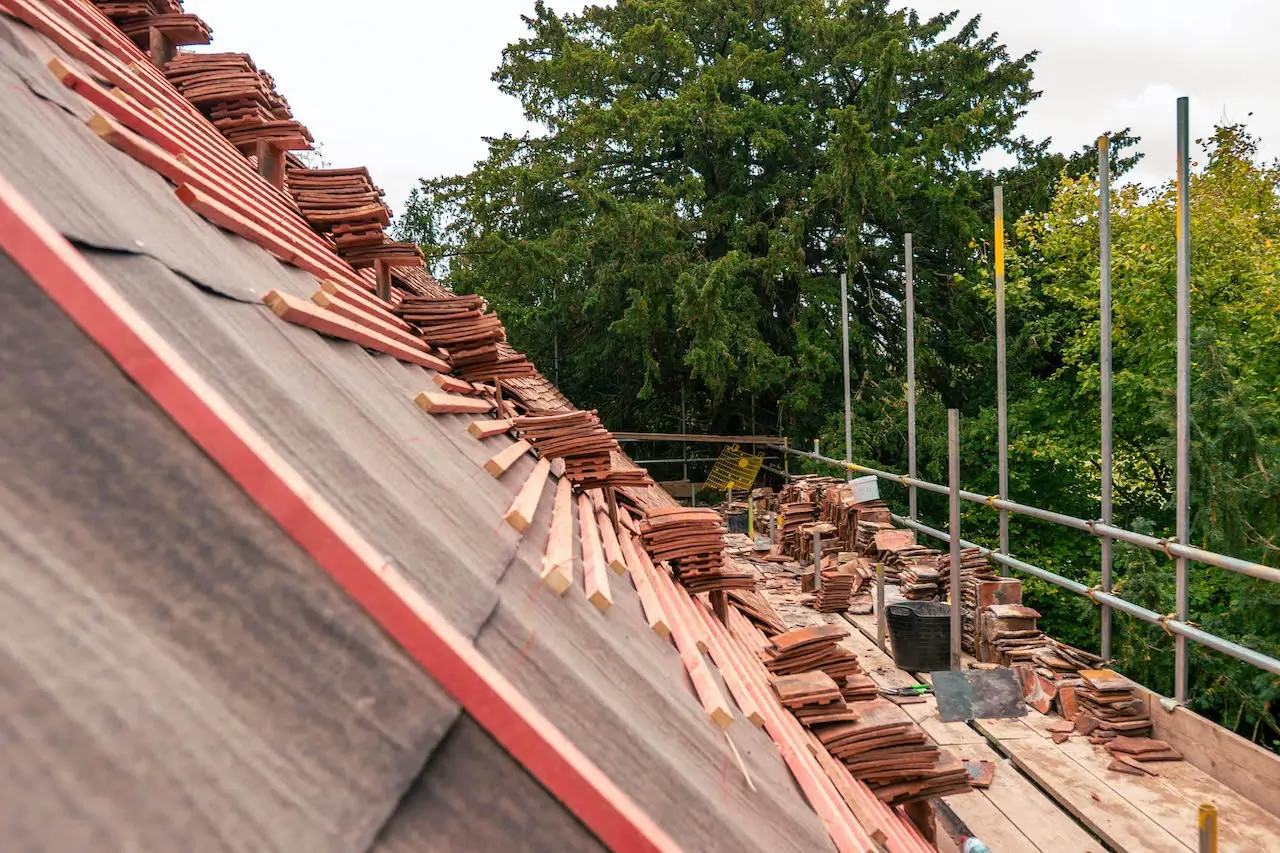
Clay tile is fired earthenware, shaped either flat (plain tile) or with a curved profile (pantile) or with an interlocking edge that overlaps the tile beside it. The material was the default UK roofing tile for centuries before concrete arrived, and remains the choice for anyone who wants the traditional warm-red or brown clay look without the cost or weight considerations of natural slate.
What makes clay excellent is that it ages properly. A fresh clay tile has a slightly artificial evenness of tone. Ten years in, that has weathered into a mellowed, softly variegated finish that reads as unmistakably right on a rural British roof. Concrete does not do this. Clay does. It's also chemically inert once fired, so like slate the material itself is effectively permanent, what fails eventually is the fixings and the mortar detail.
When it makes sense
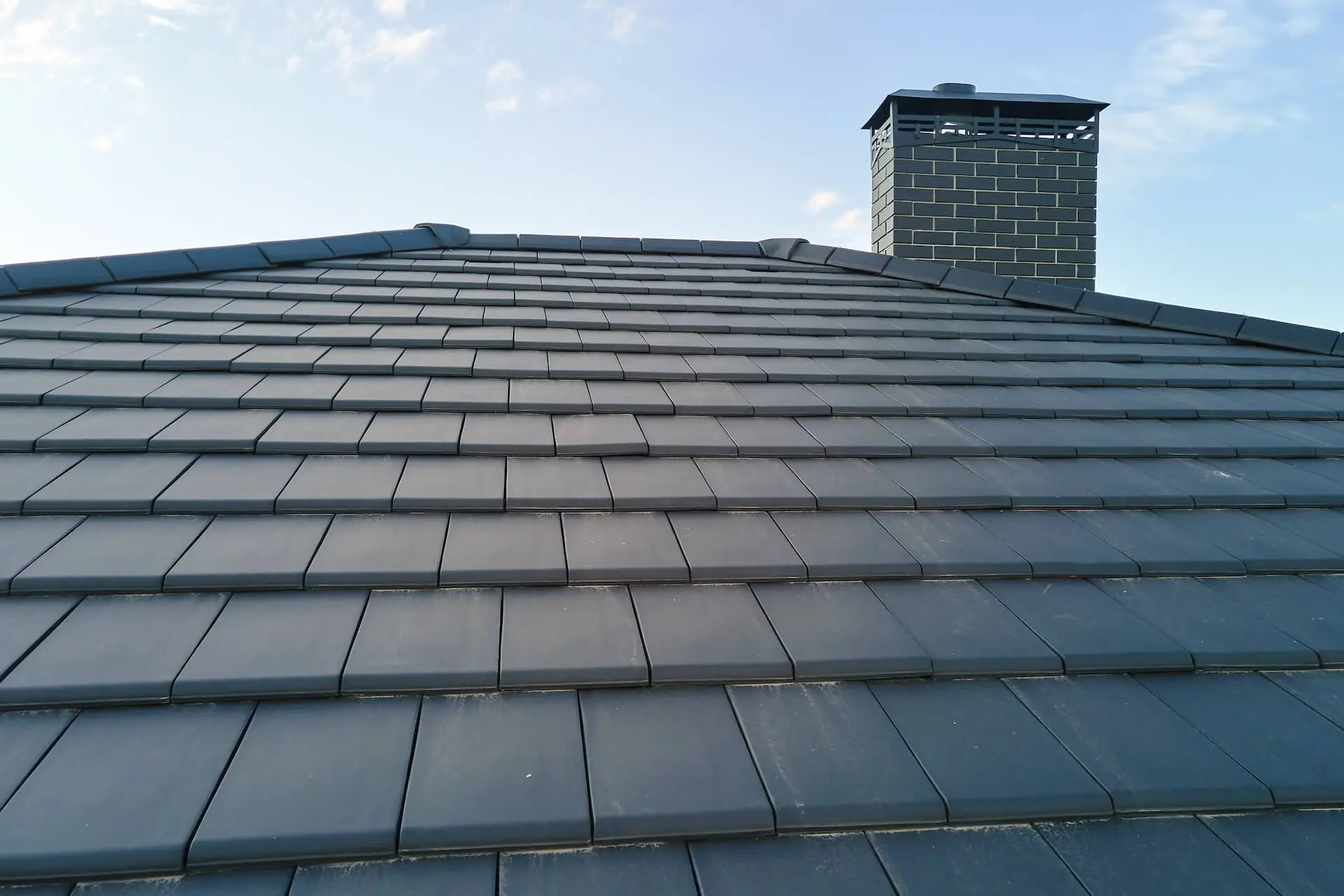
Clay is the honest answer for period cottage, for a 1930s semi in a mature suburb, for a quality new build where the developer or homeowner has specified a premium roof, and for any village property where matching the neighbours matters. It's also increasingly common on higher-end contemporary architecture, flat-profile clay tiles in dark grey or black have become a specification favourite in the last decade.
What it costs
Clay sits in the middle. Installed cost is typically £80 to £130 per square metre depending on whether you specify handmade tiles (highest, used on restoration and listed work), premium machine-made tiles from a name like Sandtoft or Marley, or a mid-range interlocking clay. On the same 90 square metre semi, a clay re-roof usually lands in the £11,000 to £18,000 bracket, roughly two-thirds the cost of slate and roughly 30 to 50 per cent more than concrete.
What can go wrong
Frost damage on cheaper tiles is the most common issue we see. A poorly fired clay tile can absorb moisture into a micro-fissure, freeze, and spall a chip off the face. Better manufacturers frost-test to a standard that avoids this, cheap imports don't always. The other common failure is nib snap on interlocking clay, the small clay projection that hooks the tile to the batten can fatigue after 50 or 60 years and lead to slipped tiles. Neither is catastrophic. Both are addressed by using reputable stock in the first place.
Concrete tile: the modern default
Concrete tile is exactly what it sounds like: sand, cement, pigment and water, pressed into a mould and cured. It was invented in the nineteenth century but really became the UK default from the 1950s onward, when post-war housing needed a cheap, fast, durable roof and clay production couldn't keep up. Today, the majority of UK residential roofs built between about 1955 and 2015 are concrete tile, and the majority of volume-builder new builds still are.
The economics are the reason. Concrete tile is the cheapest of the three to manufacture, comes in larger interlocking formats that go on faster, and requires fewer specialist skills to lay. It's a genuinely good material for what it is. What it isn't is beautiful or long-lasting compared to the alternatives.
When it makes sense
Concrete is the honest answer on any roof built for concrete already, replacing like with like on a 1960s semi, a 1980s estate house or a 2005 new build. It's also the right answer for garages, outbuildings, side extensions where matching the main house is impossible, and for any re-roof where budget is the driving constraint and the property's kerb appeal ceiling is set by other factors anyway. It is not the right answer for period property, conservation-area property or anywhere the character of the roof genuinely matters.
What it costs
Concrete is the cheapest of the three. Installed cost is typically £55 to £90 per square metre. On the same 90 square metre semi, a concrete re-roof usually lands in the £8,000 to £13,000 bracket. That price advantage is real and, on the right property, entirely defensible.
What can go wrong
Two things. First, colour fade. The pigment in a concrete tile sits at the surface only. Over 20 to 30 years, UV and rain leach that surface pigment and the tile fades to an uneven grey, sometimes with algal streaking. The tile is still watertight. It just looks tired. Second, the tile weight puts more load on the roof structure than slate or clay would, which is fine on a roof designed for concrete but a real consideration if the original roof was lightweight.
The right tile is the one that suits the property, the pitch, the pocket and the postcode. Not the one the salesman is pushing this week. the family, on most surveys
Pitch, weight and structure: what your rafters need to know
The three tiles are not interchangeable at random. Two things about your existing roof will genuinely constrain the choice.
The first is pitch. Every tile has a manufacturer-declared minimum pitch below which water starts to work its way sideways under the laps and the roof leaks. Natural slate is around 25 to 30 degrees depending on slate size. Plain clay tile is similar. Interlocking clay can go down to about 22.5 degrees. Interlocking concrete can go down to 17.5 degrees on the shallow-profile products. If you own a 1970s bungalow with a 20-degree pitch, natural slate is off the table without a structural pitch change, whether you want it or not.
The second is weight. Concrete tile weighs roughly twice what natural slate does per square metre. Clay sits between the two. If a roof was designed and built for slate in 1890 and someone replaced it with concrete in 1985, the rafters may already be under more load than the original spec intended, and any modern re-roof will need a structural review. Going the other way is simpler, concrete-designed rafters take slate or clay easily. As part of a re-roof quote we always check the roof structure, wall plates, purlins and rafter spans against the proposed material. It's the thing most cheap quotes leave out.
Cost per m² compared honestly
Because a comparison is only useful if it reflects real prices, here is what a like-for-like 90 square metre re-roof on a three-bedroom semi in Milton Keynes typically costs in 2026, including strip, felt, batten, tile, ridge, verges, standard lead-work and scaffold.
- Concrete tile: £8,000 to £13,000. Fastest to lay, lowest labour cost, cheapest materials. A well-executed budget option.
- Clay tile: £11,000 to £18,000. Middle ground on materials and labour. A step up in kerb appeal and lifespan that most homeowners recover on resale.
- Natural slate: £18,000 to £30,000. Highest materials and labour cost. Whole-life cost is often lower than concrete because the roof lasts two or three times as long, but the upfront cheque is significantly larger.
These are honest ranges from our own recent job book. A national firm's quote can be 30 to 60 per cent higher than the top of these ranges. A cash-in-hand quote can be 30 per cent below the bottom. Neither is where you want to end up.
Which tile for which UK property style
The single most reliable way to choose the right material is to look at what the property was originally built with, and match it. In four decades on Buckinghamshire roofs, we've seen enough mismatches to know that the surest way to devalue a house is to put the wrong roof on it.
- Period cottage (pre-1900, stone or brick): handmade clay peg tile or natural slate, matched to whatever the property and its street originally had. Concrete is rarely appropriate and often refused by planning.
- Victorian terrace (1840 to 1900): natural Welsh slate is nearly always the original and correct answer. Reclaimed Welsh slate is the gold standard on restoration.
- 1930s semi (interwar): clay tile is nearly always original. Plain clay or a warm-toned interlocking clay is the right match. Concrete on a 1930s semi always reads as a compromise.
- Post-war and mid-century (1945 to 1975): concrete tile was originally specified on most of these, and replacing like with like is the honest answer. A quality interlocking concrete is fine here.
- Modern new build (1990 to today): depends entirely on the developer's original spec. Volume builders use concrete. Higher-end developers use clay. Match what's there.
- Listed or conservation-area property: the planning officer decides, not you. Nearly always natural slate or handmade clay, matched to the surrounding fabric.
The Clarkson recommendation
If you ring us for a survey, this is roughly how the conversation on material choice tends to go.
On a Victorian or Edwardian property with slate originally, we'll recommend slate, and specifically reclaimed Welsh slate where the budget allows. It's the material the house was designed for, it's the material the street expects, and it's the material that maintains the property's resale value.
On a 1930s semi with clay tile originally, we'll recommend clay tile again, in a warm brown or terracotta tone that matches the neighbours. A modern interlocking clay from Sandtoft, Marley or Redland is usually the sensible choice, handmade only where the property is exceptional.
On a 1970s semi with concrete originally, we'll recommend a good interlocking concrete tile, replacing like with like. Upgrading to clay is defensible if you plan to stay long-term and the extra £3,000 to £5,000 doesn't hurt. Upgrading to slate almost never makes economic sense on a property of this style.
On a new build with any tile originally, match what's there. The property was designed as a coherent whole and swapping the roof to a different material rarely improves it.
On a listed or conservation property, we'll help you talk to the conservation officer before we quote, because they have the final say and it's cheaper to know that before we start.
Where we won't push you is toward the most expensive option for the sake of it. Slate is glorious. It's also wrong on plenty of houses, and if a decent concrete re-roof will genuinely serve your property well for the next 50 years, that's the honest recommendation and that's the one we'll make. A quote from us will always give you the plain reason behind the material we've specified, so you can push back on it if you want to.
Not sure which tile is right for your property? Ask the family.
Common questions.
The questions homeowners ask us most often when they're weighing slate against clay against concrete.